
I’m so excited today to bring you this guest review, from my friend and law school classmate Jonathan Zasloff. Jonathan is a professor at UCLA Law School, and a recently-ordained rabbi. As you’ll see, he is a wonderful writer and thoughtful reviewer. I hope I can feature his reviews often!
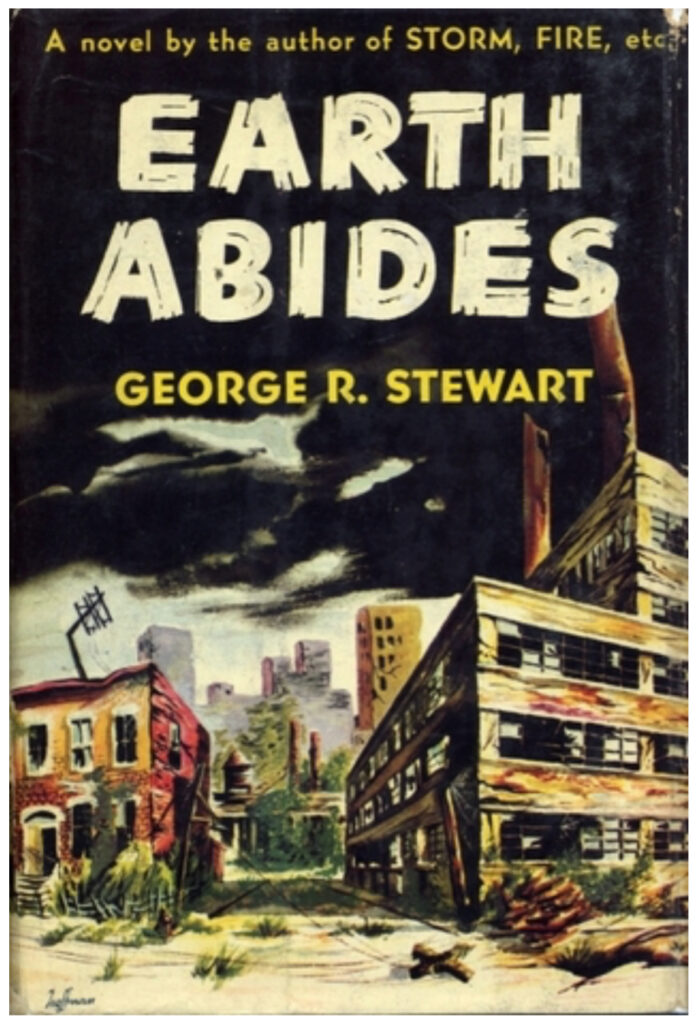
Earth Abides, by George Stewart
Post-apocalyptic literature seems to take on more relevance every day, and since 2016, I have become more and more of a connoisseur of the genre. Earth Abides, originally published in 1949, is something of the Ur-text of the genre.
Isherwood Williams, a geography grad student, discovers that virtually all of the world’s human population has been wiped out by a strange disease, and Earth Abides chronicles the rest of his life, the people he meets, and the community he helps form. What struck me the most about this book is its quietness — even with some awful problems, there are no other great disasters, just a gradual decay. Thus the title, from Ecclesiastes (1:4): “Generations come and go, but earth abides.”
I couldn’t help seeing the Jewish — or at least the Biblical — angle. Isherwood goes by his nickname, “Ish” — which just so happens to be the Hebrew word for “man.” His wife is “Emme,” which just so happens to be awfully close to the Hebrew word for “mother.” His best friend is named Ezra, which just happens to be the Hebrew word for “helper.” In the Bible, Ezra is a scribe, who through force of will recreates the Israelites’ religious civilization. This Ezra does not.
And is that bad? Is it a problem? Suppose civilization peters out. Should we mourn that?
It’s a question that, between the rise of fascism and the warming of the earth, we need to ask more urgently. If the answer is yes, what do we do? I got a little weepy seeing Ish board up the Bancroft Library in Berkeley, knowing that very soon no one will be able to read the precious volumes inside, yet doing it anyway. Later, the rust slowly corrodes the Bay Bridge.
Earth Abides has been in print continuously now for 70 years. It has, well, abided. I wonder whether, in seven more decades, it will lie in an abandoned library, with no one around to read it.