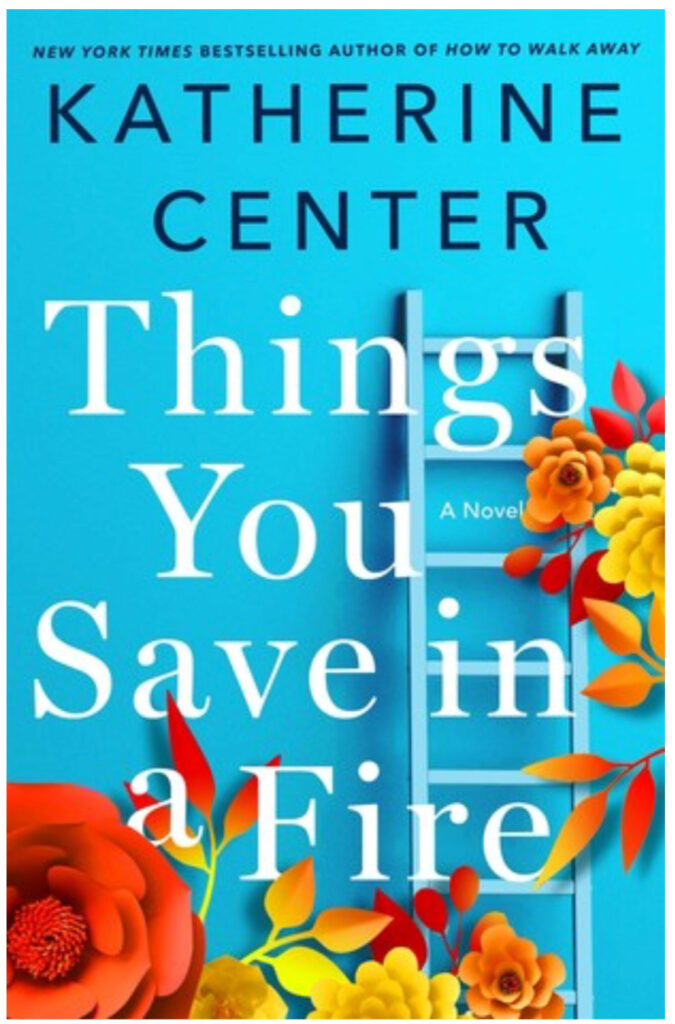
This is the second novel I’ve read by Houston novelist Katherine Center. I didn’t like this one quite as much as the last one (How to Walk Away) but this one is enjoyable. The novel focuses on paramedic and firefighter Cassie Hanwell, who deals with a past personal trauma while moving to the northeast to help her mother during a medical crisis. The firefighting details are interesting and I liked the main characters.
The writing here is definitely a cut above a typical genre romance, and much of the story is charming and engaging. That said, this is really a straight-up romance novel, and romance is not a genre I particularly enjoy. (I like a good love story, and a well crafted romantic story line is always welcome in a novel, but genre romance is not my thing.) I was reminded of that while reading this novel, as there were a number of times that I found myself rolling my eyes.
This is basically a good rom-com with some serious underlying themes of trauma and forgiveness. If you do like romance novels, I highly recommend this one – I think you’ll love it. If not, I’d skip it.
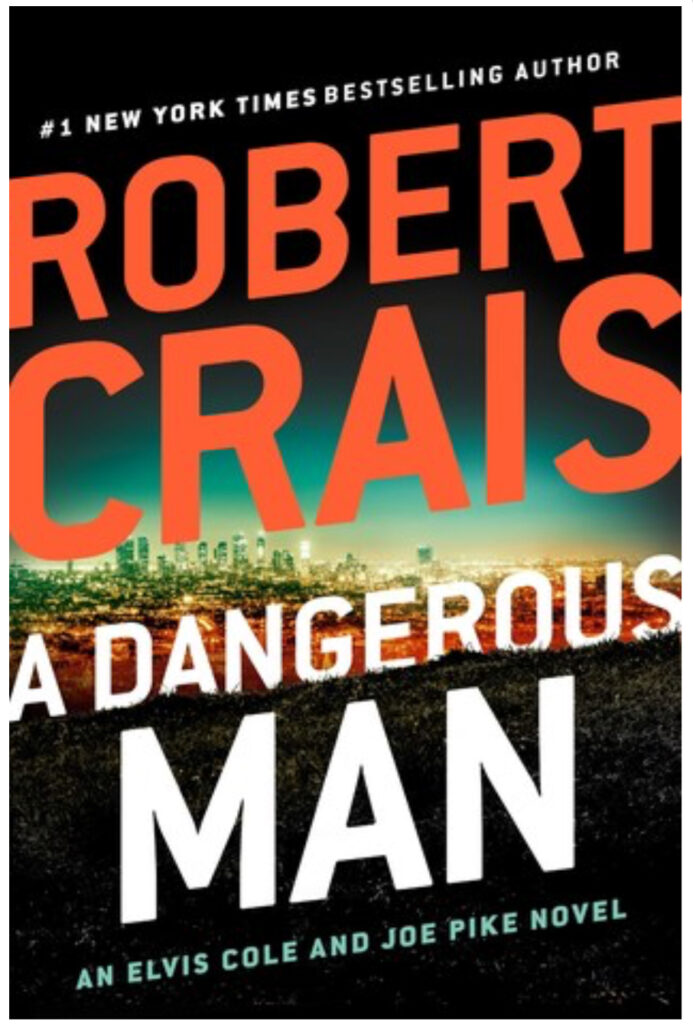
A Dangerous Man, by Robert Crais (Elvis Cole #18, Joe Pike #7)
Robert Crais writes two wildly popular series featuring wise-cracking private investigator Elvis Cole and his ex-military, ex-mercenary side kick, Joe Pike. Some of the books focus more on Cole as the main character, and others on Pike, with Cole only as a minor character. A Dangerous Man is a Pike-centric story, where Pike happens to be on the scene at a bank when a bank teller is kidnapped. He quickly rescues her, and then tries to keep her safe from a band of mysterious bad guys.
These books are not high literary art, but I enjoy them for the same reason I like (or used to like) the Jack Reacher series: sometimes you just need mindless entertainment where a really bad-ass guy (or gal!) takes on the bad guys and wins. This is that kind of entertainment, and I enjoyed it for that reason. Some of the characters are one-dimensional, in particular the young female characters (who do a LOT of giggling, for some reason), but this is not the kind of book that you read for deep character descriptions. The dialogue with Cole is snappy, Joe Pike makes the bad guys pay, and for a few hours, the real world fades away.
Give these two series a shot if you’re looking for fun, entertaining crime fiction.
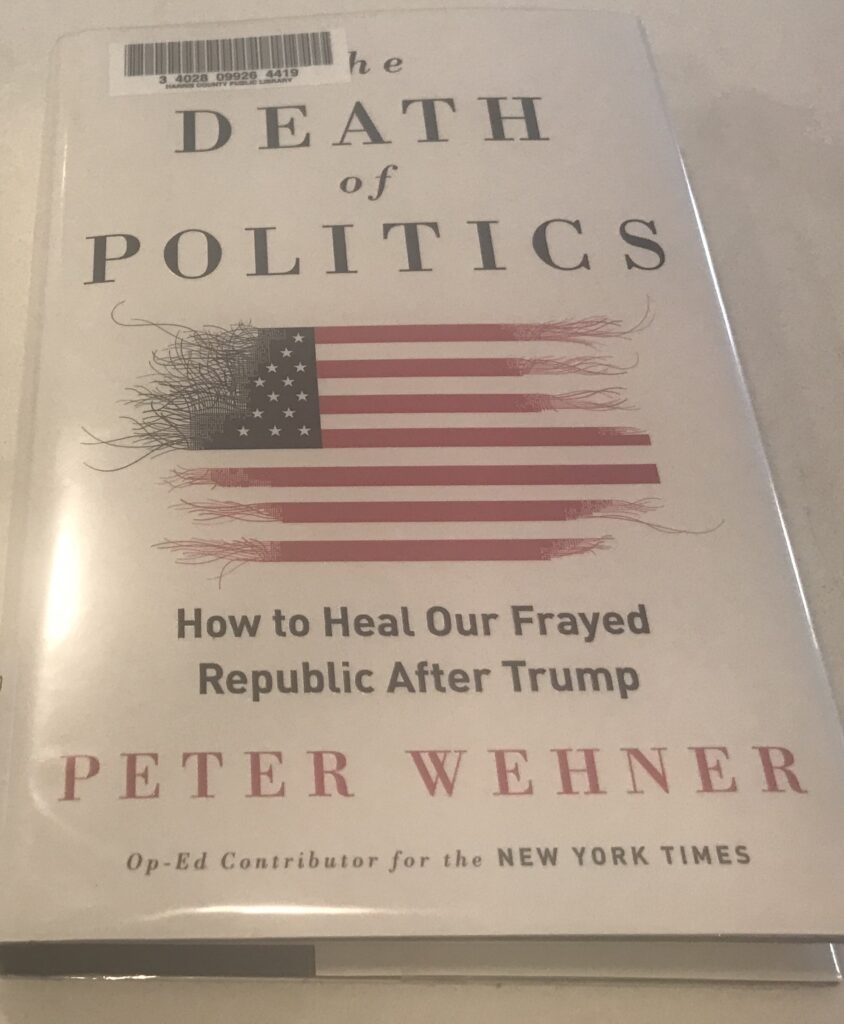
In The Death of Politics, Peter Wehner argues that our uniquely American political tradition is dying, and that the death of that tradition is having and will have terrible consequences for our country. Wehner worked in three different Republican administrations, spending three decades in the highest levels of government. Ultimately, he spent seven years in the George W. Bush White House as deputy director of speechwriting and then as Director of the Office of Strategic Initiatives (which was basically an in-house think tank). He also worked on the staff of two presidential campaigns – George W.’s re-election campaign and Romney’s 2012 campaign. So, it would not be an overstatement to say that he spent the vast majority of his working life as a committed Republican.
Wehner begins by analyzing “how we ended up in this mess.” He believes that Trump is unfit to be President, and in fact is “precisely the kind of person our system of government was designed to avoid, the type of demagogic leader our founders feared.” If that’s the case, how did we get here? He argues that Trump’s election is the result of a toxic combination of a contempt for politics and politicians, along with demographic disruptions, economic anxieties, and political polarization.
After analyzing how we got to the current state of our political discourse, he provides detailed suggestions for ways that we might move forward toward healing. He argues that we need to restore the idea that politics is a serious craft, deserving of respect and also of candidates who are worthy of that respect. He thinks faith, civics, moderation, compromise, and civility should be modeled by each individual in their own communities, in an attempt to raise the level of our public conversation and move the culture to a more positive place. He explains:
“The task of citizenship in America today is not simply to curse the political darkness but to light candles. This can be done one person at a time, in your neighborhood and city, at a homeless shelter and a school board meeting, at neighborhood gatherings and city councils, and in countless other settings.”
The Death of Politics stands as a reminder, and maybe a harbinger, that the “qualities that the most active and engaged Americans demand in politicians is what they will get. If enough citizens lend their hands and hearts, their voices and votes to men and women who embody, even imperfectly, intellectual rigor and wise judgment, mastery of government and moral integrity, our politics will be transformed. But we have to care enough to act. We can’t be a nation of onlookers.”
Wehner believes that the problems we currently face as a nation are not beyond our capacity to repair, but that in order to do so we must “recover a sense of the importance of politics, a respect for the craft of governing and the value of competence and excellence.”
I grabbed this book at the library but soon after starting it I wished I had bought it instead, because I found that I wanted to underline something on almost every page. I will probably buy a copy and re-read it with a highlighter handy. This book really spoke to me on an emotional level — not only because I can indentify with Wehner ideologically, but also because I have become so discouraged about the state of our politics that I sometimes wonder if I’m actually teetering on the verge of clinical depression. This book provided a necessary spark of hope for me, as well as an important reminder about the critical importance of our political traditions. Maybe it can do that for you, too.
I highly recommend this thoughtful book. Let’s light some candles!
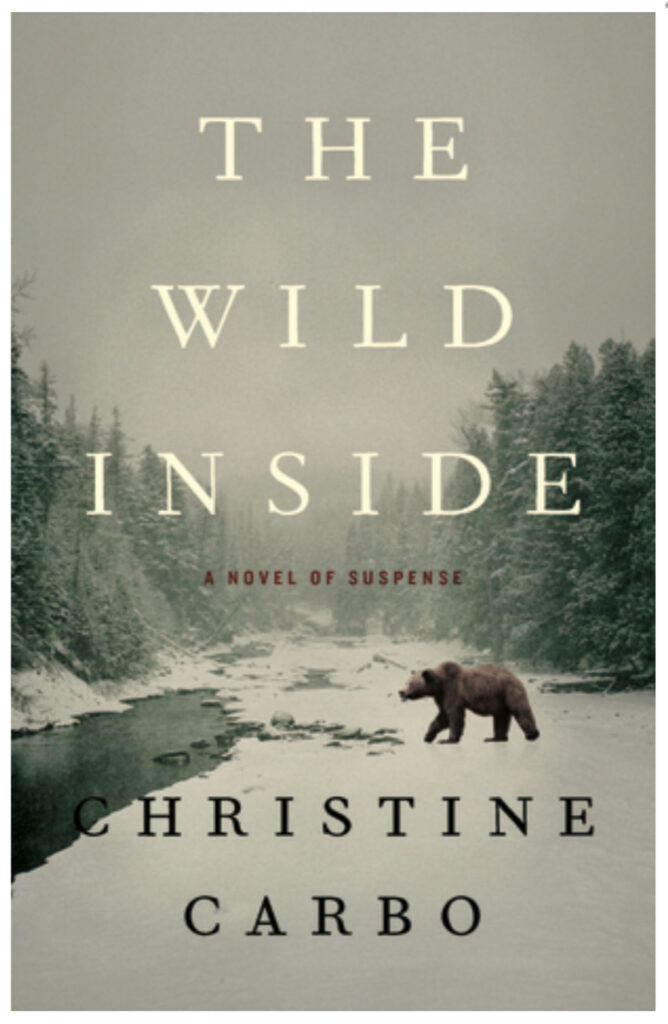
The Wild Inside (Glacier Mysteries #1), by Christine Carbo
This series landed on my radar screen due to an email blast from Murder by the Book (an excellent small book store here in Houston that is really the authority on all things mystery-related). I love mysteries set in the National Parks, but there aren’t many of them out there. For years, I read Nevada Barr’s series about a park ranger who solved crimes, though lately I have found that series disappointing and I no longer keep up with it. So, I was excited to discover this series set in Glacier National Park, which is now on book #4. We visited Glacier two summers ago — it had long been on my bucket list — and it was an amazing experience. Glacier is now one of my favorite parks, so I couldn’t wait to dive into this series.
I started with the first book in the series, The Wild Inside, which introduces the character of Ted Systead, a detective for the Department of the Interior, charged with investigating crimes in the National Parks. Ted is sent from Denver up to Glacier National Park to solve an apparent homicide, where the victim was tied to a tree and left to be mauled by a grizzly bear. Complicating matters is the fact that Ted lost his father to a bear mauling when he was only fourteen. That experience haunts him and impacts his ability to rationally approach the murder case.
This book was a bit of a mixed bag. Carbo is a very skilled writer, and I felt like the writing in this novel was a cut above that of a typical genre mystery. Of course, I loved the setting and Carbo is clearly very familiar with the park and with that area of Montana. However, the pacing of the story was a bit off — there were parts of the book that dragged and really kept it from holding my interest. While I was interested enough in the story to hang in there to see how it would end, I never really felt like anyone was in any danger (so, no real suspense), and the stakes just didn’t seem to be very high for anyone. Ted’s personal demons were central to the story and gave it complexity but also seemed overdone. Overall, I think this book could have benefitted greatly from some editing.
I wasn’t blown away by this book but I am intrigued enough by the idea of the series to read book #2 at some point. You might give it a try if you are looking for a new mystery series and/or if you are drawn, as I am, to this setting.