
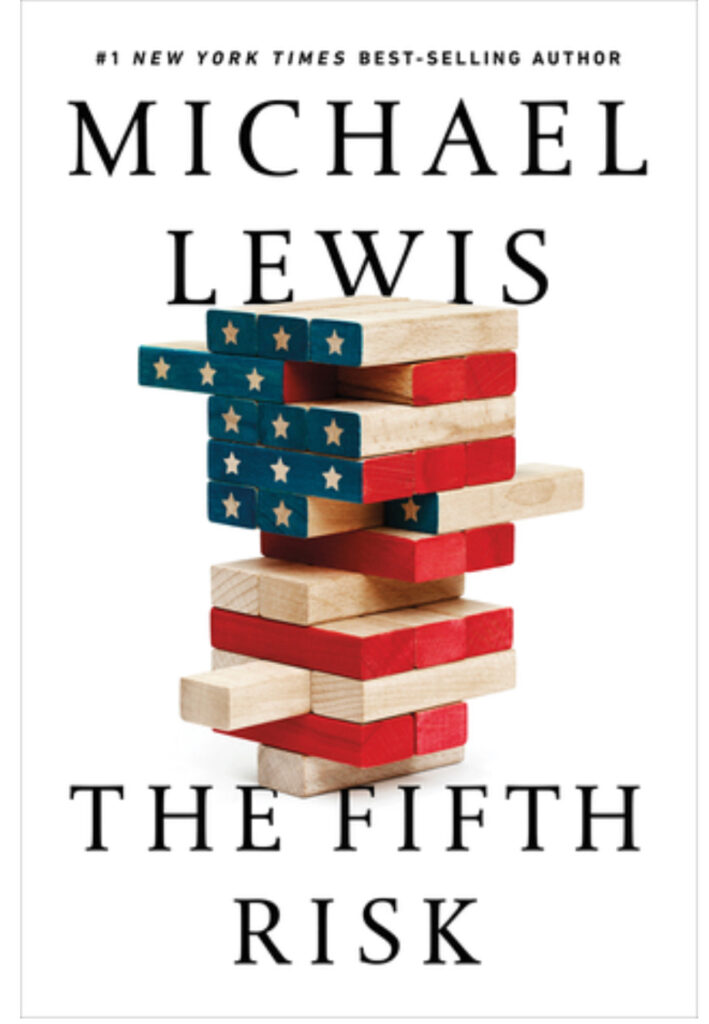
The Fifth Risk, by Michael Lewis
Warning: long read!! So, more and more I find myself realizing just how LITTLE I know and how much there is to learn. Maybe it’s a consequence of aging (like watching more and more PBS?) but anyway, it happens to me a lot, but especially when I was reading The Fifth Risk. I was blown away by how little I knew about crucial government agencies and how they affect our lives. (H/T to Jolynn Dellinger – her review of this book on Goodreads is what motivated me to read it.)
I am recommending this book to you because more than ever I think we all need to be aware of and appreciate the role that our government plays in so many aspects of our lives. Before I go further I will admit that I generally think of myself as a “small government” kind of gal, and someone who is outraged by government waste and excess. Having said that, reading this book gave me a new appreciation for the essential importance of many of the functions of our admittedly massive bureaucracy and of the career professionals at these agencies who are committed to public service.
Lewis has written many great books that I’m sure you’ve heard of, including Moneyball, The Big Short, and The Blind Side. Similarly, this book is wonderfully written and very engaging, even though it focuses mainly on the Trump transition, and on the organization and function of three government agencies: the Departments of Energy, Commerce, and Agriculture.
I had no idea how many important things are handled by the Department of Energy: maintaining and guarding our nuclear arsenal, including tracking and securing plutonium and uranium at loose in the world; training every international atomic-energy inspector; supplying radiation-detection equipment to enable other countries to detect bomb materials; conducting science on nuclear material (a science budget in the billions!), and managing disposal/containment of massive amounts of nuclear waste. So, these are big – some might say, existential – matters. Given that, you might be alarmed at the way Lewis describes the transition of this department. Basically, the department prepared for a year before the election to transition the department in the same way that Bush did for Obama. Let that sink in for a moment – the activities/responsibilities of the DOE are so vast, so varied, and so complex that the employees spent a YEAR preparing the transition materials for their department. Then the election happened, and the DOE was ready the very next day for people from the Trump team to arrive and begin learning. No one came. A month went by. A MONTH. No one came. Then one guy – Thomas Pyle, President of the American Energy Alliance – arrived for a meeting with the outgoing Energy Secretary (Ernest Moniz, a nuclear physicist). He spent ONE HOUR at the agency, took no notes, asked no questions, and seemed disinterested. He left, and never returned. Eventually, Rick Perry was nominated to be Secretary of Energy. Yes, that Rick Perry, who had famously opined that the Department of Energy should be eliminated. (I’ll give Perry the benefit of the doubt and assume that, like me, he had no idea what the DOE really does, and that now that he does know, he’s committed to the mission….). Along with Rick Perry, Trump’s appointments to positions at DOE included many personal associates of his who had absolutely no background in science. In fact, several lacked college degrees, which made them ineligible for the high level government positions to which they’d been appointed.
The story is the same, and equally distressing, for the Departments of Agriculture and Commerce (did you know that the National Oceanic and Atmospheric Administration, NOAA, which oversees the National Weather Service, is a part of the Department of Commerce? Bet you didn’t!). I won’t go into detail here because this is already too long – but I urge you to read the book. I think the bottom line is that the government is engaged in myriad functions that are critical to our daily lives. Most of that work is performed by dedicated civil servants – career professionals – and many of them are highly credentialed scientists. Right now, many of those same professionals are working without a paycheck. We need to value this work and protect it, but we need competent management in order to do that – indeed, that is the “Fifth Risk”: project management.
I wish I had something encouraging to say to wrap this up, but I don’t. I’ve actually had trouble sleeping since I finished this book, but still, I urge you to read it. At this incredibly fraught time in our history, I think we would all be wise to know more about our government, to appreciate the complexities inherent in it, and to require expertise (or even just basic competence?) in those who aspire to lead us.